
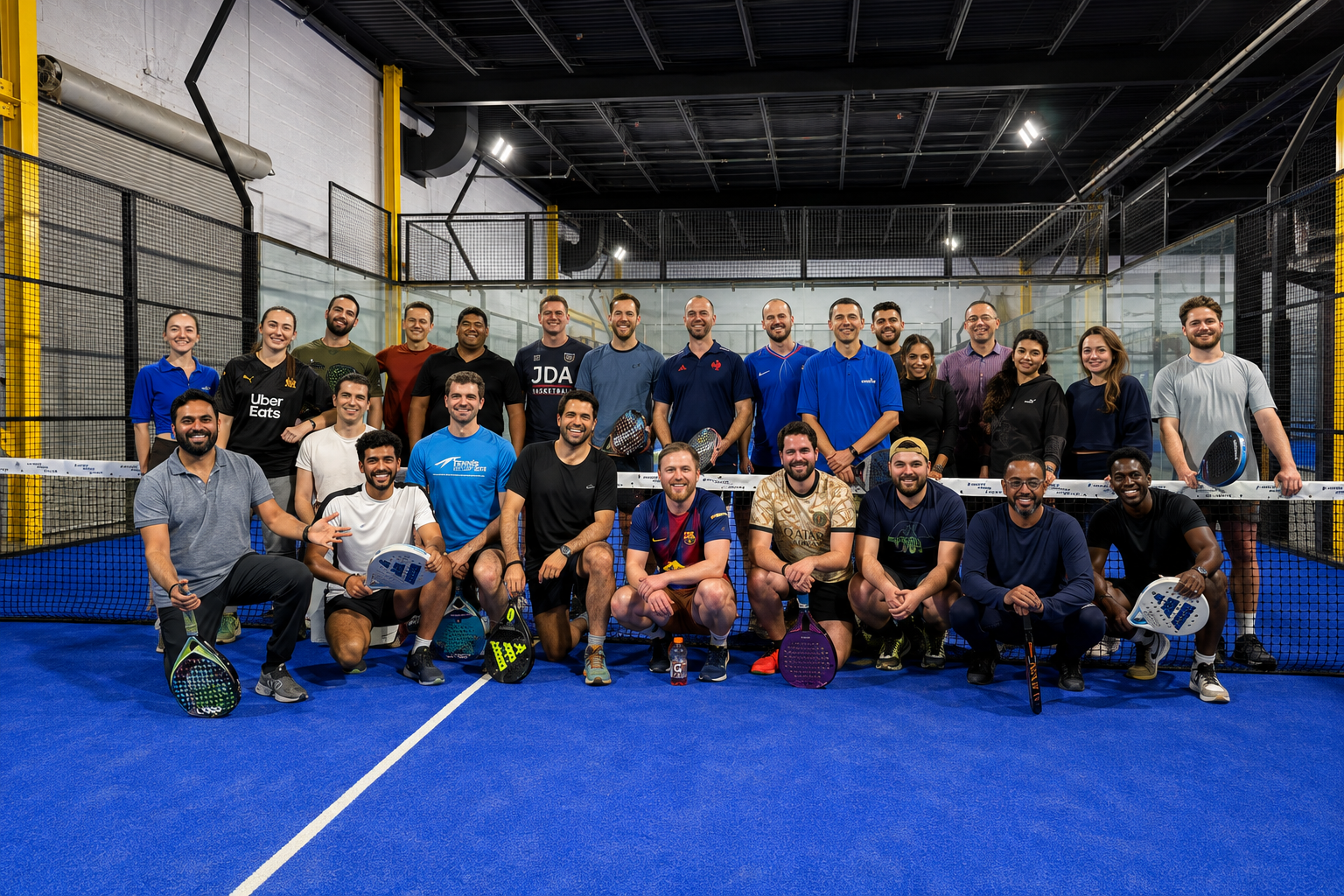
Why are Padel, Tennis, and Pickleball the fastest-growing sports globally?
Have you noticed the buzz? It seems like everywhere you look, someone is trading in their running shoes for a racket or a paddle. From the glittering celebrity courts of Miami to the local parks near your home, a new kind of fitness revolution is underway.Whether you are following the rapid rise of padel in Canada or watching community courts spring up worldwide, it’s clear we are witnessing a triple threat: padel, tennis, and pickleball.
These aren’t just sports; they’re social movements. They offer a perfect blend of competitive thrill, low-impact exercise, and, most importantly, a fantastic way to hang out with friends.
Everyone, from lifelong athletes to complete beginners, is finding a court to call home. But with all three dominating the headlines, it can get confusing. Are they all just the same game with different names? Absolutely not!
This guide by the North Padel Club is about to make you an expert on the nuances of each sport, helping you decide which one deserves your court time.
Padel vs. Tennis vs. Pickleball – The Comparison Table
To get right to the heart of the matter, here is your essential, at-a-glance guide. This table is a featured snippet-optimised goldmine, combining the most critical distinguishing factors for a quick and comprehensive understanding.
| Feature | Padel | Tennis | Pickleball |
| Court Type | Enclosed (Glass/Mesh walls in play) | Open (Lines define boundaries) | Open (Badminton court size) |
| Court Size | Small/Medium (20m x 10m / ~66 x 33 ft) | Large (23.77m x 10.97m / 78 x 36 ft) | Smallest (13.41m x 6.10m / 44 x 20 ft) |
| Racket/Paddle | Solid, perforated paddle (Pala) | Strung racket (Spring-like effect) | Solid, composite paddle (like a ping-pong bat) |
| Ball Type | Depressurised tennis ball | Standard pressurised tennis ball | Perforated plastic wiffle ball |
| Serve | Underhand (must bounce once) | Overhand (powerful) | Underhand (no bounce before contact) |
| Key Rule/Zone | Walls are used to return the ball | The ball must stay within the court lines | “Kitchen” (No-Volley Zone) |
| Standard Play | Always Doubles | Singles or Doubles | Singles or Doubles |
| Pace & Physicality | Fast, strategic, high endurance | Fastest, explosive power, high impact | Slower, low-impact, precise placement |
The differences in equipment (rackets, balls) and court design (walls, size) dramatically change the strategy and physicality of each sport. Padel is a strategic doubles game using the glass walls, Pickleball is a game of precision and soft hands near the “kitchen,” and Tennis remains the ultimate test of speed and power across a large court.
Padel vs. Tennis! Strategy, Walls, and Spin
The classic comparison. Padel is derived from Tennis but evolved into a different strategic beast.
When people think of a racket sport, they usually picture Tennis. It’s the global standard. Padel actually sprang directly from Tennis, invented in Mexico in the late 1960s when an entrepreneur wanted to create a more compact, enclosed court for his home.
However, Padel isn’t just “small tennis.” It has evolved into a fundamentally different game, shifting the focus from individual power to intricate teamwork and subtle strategy.
It’s the difference between a hundred-meter sprint (Tennis) and a tactical, long-distance relay race (Padel).

Court Dimensions and Enclosure
Detailed Breakdown of the Size Difference
Let’s talk size. Tennis requires a lot of ground to cover. The standard doubles court measures 23.77m x 10.97m (78 by 36 feet). Compare that to the Padel court, which is significantly smaller at 20m x 10m (66 by 33 feet).
This size difference is critical. In Tennis, a single player has a vast amount of area to defend, demanding explosive speed to reach wide shots. In Padel, the court feels cosy, keeping players closer to the net and promoting quicker transitions.
How glass and mesh walls change the dynamics
This is the non-negotiable difference. Padel is the sport where the walls are your friend. The court is surrounded by glass and mesh panels, and the ball remains in play after hitting the wall, similar to squash.
“The introduction of the walls is a game-changer. It shifts the mindset from trying to hit outright winners, the Tennis goal, to constructing a point defensively. You use the wall to slow down the rally, reset your position, and force your opponents into an error.”
~ Padel Coach at The North Padel Club
This wall factor forces defensive play and is the primary reason Padel rallies tend to be so much longer. That perfectly hit Tennis winner might just bounce off the glass in Padel, allowing your opponent to casually return it.
Equipment and Serve Mechanics
Racket vs. Pala – Power vs. Control
- Tennis Racket – This is a strung instrument. The tension of the strings acts like a trampoline or a spring, storing and releasing massive energy. This design is built for power and creating extreme topspin, allowing players to hit hard shots that curve aggressively.
- Padel Paddle (Pala) – This is a solid piece, often made of composite materials like carbon fibre, with holes (perforations) to reduce wind resistance. It has no strings. This lack of string-bed reduces power but grants exceptional control and makes it much easier for beginners to make consistent contact.
The Serve – Precision vs. Speed
- Padel Serve – The rules are strict; it must be underhand, and the ball must bounce once behind the service line before contact. The contact point must be at or below waist level. This rule instantly eliminates the high-speed ace and shifts the focus to precision placement, allowing the server to quickly rush the net.
- Tennis Serve – This is arguably the most dominant shot in the sport. It’s an overhand motion, leveraging height and body weight to generate incredible speed, often exceeding 120 mph at the professional level. The goal is often to win the point outright (an ace) or immediately set up a weak return.
Gameplay Style and Physical Demand
Focus – Tennis prioritises baseline power; Padel prioritises strategy and volleying.
In Tennis, you’ll often see two players locked in a ferocious duel from the baseline (the back of the court), trying to overpower or outrun the other. It’s a game of individual athletic dominance.
Padel, played exclusively as doubles, is about teamwork and positioning. The primary objective is to gain and maintain control of the net, where the volleys and smash shots are most effective.
Rally Length – Long and Strategic vs. Short and Explosive
- Padel Rallies – Due to the walls constantly giving the players a second chance, Padel rallies are known for their spectacular length. This requires high endurance and patience. The physical demand is often described as high-intensity, continuous movement, similar to playing two hours of soccer in a small area.
- Tennis Rallies – Rallies are typically much shorter and more explosive. A point is often decided within 3-5 shots because the sheer power of the serve or a forehand can end it quickly. The physicality is about short, intense bursts of speed and impactful deceleration.
Padel vs. Pickleball! Wiffle Balls, Kitchens, and Court Size
The comparison between the two fastest-growing sports is often confused due to the paddles.
If Tennis is the established veteran, Padel and Pickleball are the dynamic, surging newcomers. They are often lumped together because they both use solid paddles instead of traditional strung rackets. However, despite this surface-level similarity, they offer vastly different experiences, physical demands, and strategic depth.
The Padel court is a high-octane glass cage of defensive strategy, while the Pickleball court is a small, tactical grid where every inch near the net is a battle of soft hands.
The Critical Court Layout Difference
Detailed Size Comparison
Pickleball is undeniably the smallest kid on the block. A standard Pickleball court is a tiny 13.41m x 6.10m (44 by 20 feet), exactly the size of a badminton court. The Padel court, while smaller than Tennis, is still substantially larger at 20m x 10m (66 by 33 feet).
This difference means Pickleball is played almost entirely on a small footprint, demanding minimal running and making it immediately accessible to seniors or those with mobility issues.
The Enclosure vs. The Zone (The “Kitchen”)
This contrast defines the gameplay:
- Padel’s Active Walls (Squash Influence) – As we discussed, Padel is enclosed. The key dynamic is using the glass walls to keep the point alive. This adds a vertical and defensive dimension, turning a potential point-winner into a challenging rally extender.
- Pickleball’s No-Volley Zone (“The Kitchen”) – Pickleball has a 7-foot zone on either side of the net called the “Kitchen.” The crucial rule is – you cannot volley (hit the ball before it bounces) while standing inside the Kitchen. This rule, which takes influence from badminton, completely removes the power game near the net and transforms that area into a tactical zone focused on “dinking” (soft, low-bouncing shots).
According to the Sports & Fitness Industry Association (SFIA), Pickleball has seen well over 223.5% growth in participation over the last three years, largely due to its low-impact nature enforced by the Kitchen rule.
Equipment and Ball Behaviour
Padel Ball vs. Wiffle Ball
The ball is perhaps the clearest differentiator between these two paddle sports:
- Padel Ball – A depressurised version of a tennis ball. It’s softer and slightly heavier. While it doesn’t fly as fast as a standard tennis ball, it still has significant bounce, promoting a quick, flowing game.
- Pickleball Ball (Wiffle Ball) – This is a rigid, perforated plastic ball. Because it has holes, it is significantly affected by wind, has almost no bounce, and travels much more slowly. This feature is the ultimate equaliser, removing the power advantage and forcing players to rely on finesse and shot placement.

Paddle Composition
- Padel Paddle – Thicker, often with a rough surface texture to grip the ball, and built to withstand the impact of a faster ball. It is designed to allow players to hit forceful, yet controlled, overhead smashes.
- Pickleball Paddle – Generally thinner, lighter, and designed primarily for touch and feel. Its composition is geared toward absorbing the pace of the Wiffle ball and executing delicate dinks (soft shots just over the net and into the Kitchen).
Rules, Scoring, and Pace
Scoring – The Serving Side Rule
- Padel – Uses the traditional Tennis scoring system (15, 30, 40, Deuce, Advantage, Games, Sets). This is familiar and relatively easy to follow.
- Pickleball – Uses unique scoring where only the serving side can score a point. This mechanic can lead to longer games and emphasises the importance of holding serve. Games are typically played to 11, winning by two.
The Double-Bounce Rule (Pickleball)
Pickleball features a key, unique rule designed specifically to slow the game down – The “Double-Bounce Rule.”
- The serve must bounce once on the receiving side.
- The return of the serve must bounce once on the serving side.
The net effect is that players cannot rush the net right after the serve and immediately smash the ball. This enforced back-and-forth ensures that every rally starts with control, not power, making the game inherently more strategic and low-impact.
Physicality – Agility vs. Accessibility
- Padel – Requires continuous lateral movement, quick reflexes for shots coming off the glass, and high cardiovascular endurance. It’s a great full-body workout.
- Pickleball – Requires minimal running. Its focus is on excellent hand-eye coordination, precise placement, and strategic positioning near the Kitchen line. It is arguably the most accessible of the three sports for all ages and fitness levels.
This final set of sections will bring the entire post together, providing a technical breakdown followed by the crucial audience-focused advice and a strong conclusion. I will ensure the tone remains conversational and humanised.
The Triple Threat – Shared Mechanics of Padel, Tennis, & Pickleball
While their differences define them, it’s helpful to look at how their key mechanics relate. Despite the varying equipment and courts, all three sports rely on the fundamental skill of racket control. Comparing these mechanics side-by-side reveals the intent behind each sport’s design.
Serve Rules Compared (Underhand vs. Overhand)
The serve is the launchpad for the point, and the rules around it determine the game’s initial pace and strategy.
| Sport | Serve Style | Must Bounce First? | Contact Point |
| Padel | Underhand | Yes (on your side) | At or below the waist |
| Pickleball | Underhand | No (direct hit) | At or below the waist |
| Tennis | Overhand | No | Above the head (high power) |
Padel and Pickleball use the underhand serve to deliberately neutralise the power element, ensuring the game starts with a rally. The primary difference is the bounce; Padel requires a bounce for precision, while Pickleball requires a direct hit for simplicity.
Tennis uses the overhand serve to maximise speed and spin, instantly putting the receiver on the defensive.
Equipment Families
The tool you hold in your hand is the most tactile difference between the three.
- Racket (Tennis) – Strung with nylon or polyester, creating tension to act as a spring. Designed primarily for maximising spin and power through the elastic rebound effect.
- Pala (Padel) – Solid face, usually carbon or fibreglass, with perforations. The solid construction leads to a smaller sweet spot but offers phenomenal control and consistency, promoting defensive blocking and controlled volleys.
- Paddle (Pickleball) – Solid face, lighter and thinner composite materials. Designed for placement and soft dinks. Its goal is to deaden the ball’s impact, allowing for highly tactical, low-speed shots.
Net Heights
The net height seems like a minor detail, but it dramatically impacts the effectiveness of the most thrilling shots – the volley and the overhead smash.
| Sport | Net Height (Centre) | Net Height (Sides) | Volley Strategy Impact |
| Tennis | 3 feet (0.914 m) | 3 feet 6 inches (1.07 m) | Requires a steep downward angle to clear the high sides. |
| Padel | 0.88 meters (2 feet 11 inches) | 0.92 meters (3 feet) | Slightly lower than Tennis, making volleys more common and aggressive. |
| Pickleball | 34 inches (0.86 m) | 36 inches (0.914 m) | Lowest net overall, encouraging low, precise shots over the net and into the Kitchen. |
The slightly lower nets in Padel and Pickleball compared to the sides of a Tennis net are a deliberate design choice to encourage players to move toward the net and volley, leading to dynamic, close-quarters play.
Choosing Your Racket Sport – Skill, Accessibility, and Community
Now that you know the mechanics, it’s time for the most important question – which court should you step onto? The best sport for you depends on your personal goals, whether you prioritise high-octane competition, laid-back socialising, or low-impact fitness.
Who is the Target Player?
| Sport | Best For… | Key Benefits |
| Tennis | Athletes seeking high-impact, explosive, competitive singles play. | Intense cardio, explosive power development, and a global professional circuit. |
| Padel | Social players, former tennis/squash players, or athletes seeking teamwork. | Strategic, longer rallies, high social engagement (always doubles). |
| Pickleball | Beginners, older adults, and families looking for a low-impact game. | Easiest learning curve, high accessibility, minimal impact on joints. |
Barrier to Entry (Cost and Space)
- Pickleball wins on accessibility. Due to its small size, a court can be painted onto existing surfaces (like a basketball court) for minimal cost. Equipment (paddles and balls) is inexpensive and durable.
- Padel requires a specialised, fully enclosed glass court, making the initial build expensive. However, Padel centres are booming, making court rental increasingly easy.
- Tennis requires the largest space and can involve higher costs for quality strung rackets, stringing maintenance, and court time at dedicated clubs.
Global Popularity and Future Growth
- Padel – The undisputed king in Spain and parts of Latin America, Padel is experiencing massive growth across Europe, the Middle East, and Asia. It is quickly building a global footprint driven by its social, double format.
- Pickleball – An American phenomenon that has exploded in popularity, appealing to retirement communities, families, and younger adults alike. Its explosive growth rate is unmatched, indicating a strong future in North America and a growing presence abroad.
- Tennis – The established, global standard. It remains the top racket sport in terms of professional viewership, prize money, and worldwide infrastructure. It’s not growing as fast as the newcomers, but its foundations are deep and secure.
Frequently Asked Questions (FAQs)
Which sport is the easiest to learn for a complete beginner?
Pickleball is widely considered the easiest of the three sports to learn. The small court size, the slow-moving Wiffle ball, and the low-impact nature mean that new players can have successful rallies almost immediately. Padel is a close second, as the solid paddle and underhand serve make the initial learning curve easier than Tennis.
Why are Padel and Pickleball played with paddles instead of strung rackets?
The solid paddle (Pala in Padel, paddle in Pickleball) is designed to reduce power and maximise control. Strung rackets (Tennis) are built to generate high speed and spin. By using a solid face, Padel and Pickleball emphasise finesse, placement, and strategy over brute force, which also makes the equipment more accessible to players of all ages.
Can I use a Padel ball to play Tennis, or vice versa?
No, you should use the correct ball for each sport. Tennis uses a highly pressurised ball for maximum bounce and speed. Padel uses a depressurised (softer) tennis ball to slow the game down slightly in the enclosed court. If you used a standard tennis ball in Padel, the rallies would be too fast and aggressive for the small space. Pickleball uses a completely different perforated plastic Wiffle ball.
Which sport provides the better cardio workout?
Tennis and Padel generally provide a more intense cardio workout.
- Tennis demands short, explosive sprints and powerful swings, resulting in high-intensity interval training.
- Padel demands continuous lateral movement and sustained, long rallies, leading to high endurance and sustained heart rates.
Pickleball, while a great low-impact activity, focuses more on strategy and quick reflexes near the net, requiring less intense running.
Is Padel or Pickleball just a fad?
Absolutely not. Both are demonstrating massive, sustained growth globally.
- Padel has seen exponential growth in Europe, moving into serious investment territory with professional tours and dedicated clubs opening worldwide.
- Pickleball is deeply embedded in American culture and is supported by large national associations (USAPA). It is a proven, multi-generational sport with a high retention rate, suggesting it is here to stay.
Can I play Pickleball on a Tennis court?
Yes, this is very common! A standard tennis court is large enough to fit up to four Pickleball courts. You only need to chalk or tape down the Pickleball lines (including the Kitchen) and bring your portable Pickleball net, which is slightly lower than a Tennis net.
Conclusion
The racket sport revolution offers something for everyone, regardless of age, athleticism, or competitive spirit.
Do you prefer raw power and speed across the wide-open spaces of a classic court? Then grab a strung racket and hit the Tennis court.
Are you energised by teamwork and strategy, loving the idea of using walls to extend spectacular rallies? Then grab a pala and jump into Padel.
Or, do you want a highly accessible, low-impact game of strategy and finesse near the Kitchen? Then you belong with a pickleball paddle in your hand.
The only bad choice is not playing at all! Try all three, you might be surprised by which one hooks you. But if you want to book a court or a coaching lesson, consider North Padel Club, as we are the best in town.


